
When you venture into the tropical and temperate waters where cuttlefish inhabit, you'll find them thriving in complex environments like coral reefs, rocky crevices, and seaweed forests, each providing unique shelter, food, and protection from predators. These habitats shape cuttlefish behavior, from maneuvering through coral reef architecture to denning in secluded caves. As you explore their world, you'll discover the intricate adaptations that help them blend in, find food, and avoid predators. And as you dive deeper, you'll uncover the fascinating ways cuttlefish interact with their surroundings, and the surprising secrets they hold.
Tropical and Temperate Water Habitats
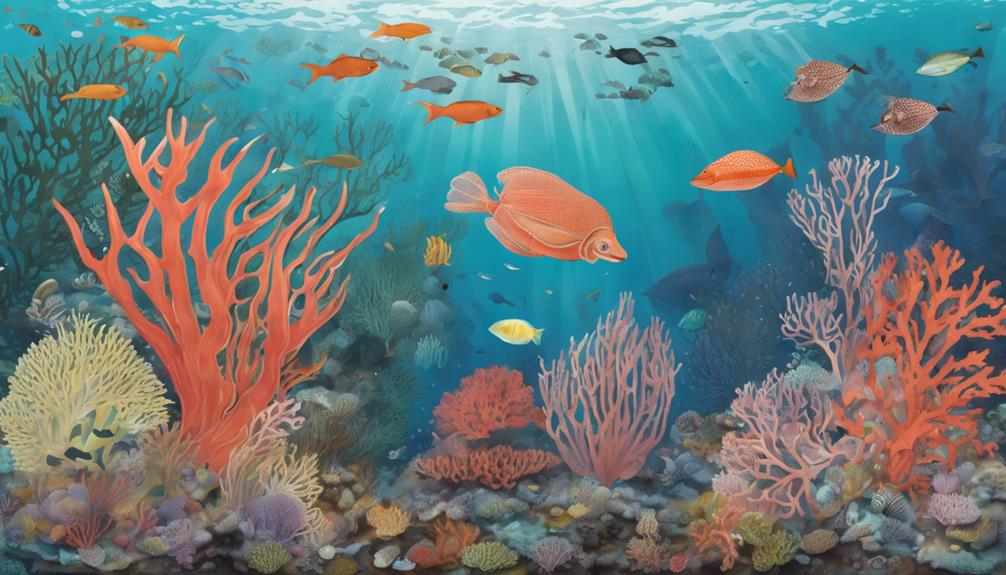
In tropical and temperate waters, you'll typically find cuttlefish inhabiting shallow, coastal areas with rocky reefs, seaweed, or seagrass beds. These habitats provide the perfect blend of food, shelter, and protection from predators. As you explore these areas, you'll notice the complex interplay between Ocean Currents and Marine Geology. The gentle lapping of waves against the shore, the tidal flows, and the ocean's currents all work together to shape the seafloor.
The unique combination of ocean currents and marine geology creates an ever-changing environment. Cuttlefish have adapted to these dynamics, using their remarkable camouflage abilities to blend in with the surrounding seaweed or rocky outcrops. They've also developed remarkable swimming abilities, allowing them to navigate the strong currents and eddies that form around reefs and seaweed beds.
As you investigate further into these habitats, you'll discover the intricate relationships between the cuttlefish and their surroundings. The seaweed and seagrass provide shelter from predators, while the rocky reefs offer a haven from strong currents. In return, the cuttlefish help maintain the balance of the ecosystem, preying on small crustaceans and fish that might otherwise overgraze the seaweed. By understanding these intricate relationships, you'll gain a deeper appreciation for the remarkable adaptability of cuttlefish in their tropical and temperate habitats.
Complexity of Coral Reef Environments
You'll be struck by the sheer complexity of coral reef environments, where cuttlefish navigate a labyrinth of nooks and crannies amidst a kaleidoscope of colors and life. As you explore these vibrant ecosystems, you'll notice the intricate reef architecture, with towering coral formations, narrow passageways, and hidden caverns. The cuttlefish's remarkable ability to change color and texture allows it to blend seamlessly into this dynamic landscape.
Ocean currents play a vital role in shaping the reef's structure, with strong currents creating narrow channels and gentler flows forming broad, sandy basins. The cuttlefish has adapted to these currents, using them to its advantage as it searches for prey or avoids predators. You'll see how the reef's architecture influences the cuttlefish's behavior, as it weaves through the coral, using the currents to conceal its movements.
As you explore deeper into the reef, you’ll appreciate the intricate relationships between the cuttlefish and its surroundings. The coral itself provides a sanctuary, offering protection from predators and a bounty of food sources. The cuttlefish, in turn, helps to maintain the reef’s delicate balance, controlling populations of smaller creatures that might otherwise overgraze the coral. This remarkable symbiosis is a reflection of the complexity and beauty of coral reef environments, where the cuttlefish thrives in a world of vibrant colors, intricate structures, and ever-changing currents. As you observe these fascinating interactions, you may also wonder how to maintain cuttlefish tank balance in a home aquarium. Achieving this balance requires careful attention to water quality, proper feeding, and creating an environment that mimics their natural habitat. By ensuring that your tank replicates the complexities of the reef, you’ll not only support the health of your cuttlefish but also foster a thriving ecosystem within your aquarium.
Rocky Crevices and Secluded Caves

As you explore the natural habitat of cuttlefish, you'll find that rocky crevices and secluded caves play an essential role in their daily lives. You'll discover that these hidden spaces provide cuttlefish with safe denning sites, complex networks of tunnels, and unique coastal formations that support their existence. By examining these features, you'll gain a deeper understanding of how cuttlefish thrive in these environments.
Hidden Denning Sites
Cuttlefish seek out rocky crevices and secluded caves as hidden denning sites, where they can shelter from predators and rest in the darkness. As you explore the underwater world, you'll notice that these clever creatures exhibit a unique denning behavior, carefully selecting sites that provide best protection and concealment. When choosing a denning site, cuttlefish prioritize areas with complex structures, such as narrow crevices or cave entrances, which allow them to retreat from potential threats.
You'll observe that cuttlefish tend to favor sites with low light levels, as this helps them conserve energy and reduce their visibility to predators. Additionally, these hidden denning sites often have a stable water flow, which helps maintain a consistent oxygen supply and prevents the buildup of waste products. By understanding the denning behavior of cuttlefish, you'll appreciate the importance of site selection in their natural habitat. As you explore further into the world of cuttlefish, you'll discover the intricate relationships between these intelligent creatures and their environment.
Complex Cave Systems
Complex cave systems, comprising rocky crevices and secluded caves, provide cuttlefish with a labyrinthine network of hiding spots and escape routes. As you explore the underwater world of cuttlefish, you'll discover that these intricate cave systems are essential for their survival. The detailed networks of tunnels and chambers offer protection from predators and harsh tidal currents. You'll notice that the cave formations, shaped by the relentless pounding of waves, create a maze-like environment that's perfect for cuttlefish to navigate and hide.
As you investigate further into these cave systems, you'll find that the rocky crevices and secluded caves provide a sense of security for the cuttlefish. The narrow passages and dark recesses allow them to rest, hide, and even hunt for prey. The tidal currents, which can be strong in these areas, actually help to flush out prey and bring in nutrients, making these cave systems a hub of activity for the cuttlefish. By understanding the importance of these complex cave systems, you'll gain a deeper appreciation for the intricate relationships between the cuttlefish and their underwater environment.
Coastal Reef Formations
Beyond the intricate networks of cave systems, you'll find coastal reef formations punctuated by rocky crevices and secluded caves that provide cuttlefish with additional sheltered havens. These unique features of reef architecture offer a sense of security for cuttlefish, allowing them to retreat from potential predators or harsh environmental conditions. The rugged coastal landforms, shaped by the relentless pounding of waves, have created a labyrinth of nooks and crannies perfect for cuttlefish to hide and hunt.
As you explore these reef formations, you'll notice the rocky crevices and secluded caves are often narrow and winding, providing a maze-like refuge for cuttlefish to navigate. The complex structure of these formations allows cuttlefish to move undetected, using their remarkable camouflage abilities to blend in with their surroundings. The sheltered nature of these coastal landforms also provides a sense of stability, protecting cuttlefish from strong currents and ocean swells. By understanding the importance of coastal reef formations in the cuttlefish's habitat, you'll gain a deeper appreciation for the intricate relationships between these fascinating creatures and their environment.
Seaweed Forests and Kelp Beds
As you explore the seaweed forests and kelp beds, you'll discover that these underwater landscapes provide cuttlefish with an essential habitat. You'll find that the towering kelp and seaweed fronds offer shelter and protection from predators, while the complex network of stems and leaves creates a labyrinth of hiding spots. As you venture deeper, you'll see that the forest floor, too, plays a vital role in the cuttlefish's daily life.
Seaweed Provides Shelter
You'll often find cuttlefish hiding in the dense, swaying fronds of seaweed forests and kelp beds, where the thick vegetation provides them with shelter from predators and a place to ambush prey. As you explore these underwater landscapes, you'll notice the intricate seaweed architecture, with towering kelp stalks and delicate fronds that create a complex network of hiding spots. The cuttlefish have adapted to this environment, using their remarkable camouflage abilities to blend seamlessly into the seaweed's muted colors. The seaweed's dense foliage also provides a safe haven from strong currents, allowing the cuttlefish to conserve energy and focus on hunting. In this underwater world, the seaweed's towering structures create a unique landscape, with the cuttlefish skillfully maneuvering through the seaweed's twists and turns. As you investigate further into this ecosystem, you'll appreciate the intricate relationship between the cuttlefish and their seaweed shelter, where the underwater landscaping provides a delicate balance of safety and predation.
Kelp Bed Complexities
Diving into the kelp bed's complexities, you'll discover a labyrinthine network of towering stalks, fronds, and holdfasts that provide a multitude of hiding spots and escape routes for the cuttlefish. As you navigate through this underwater world, you'll notice the intricate kelp architecture, with its sturdy stalks and flexible fronds that sway gently in the current. The fronds, in particular, play an essential role in the kelp bed's ecosystem, providing shelter and protection for the cuttlefish.
The frond interactions are fascinating, as they create a dynamic, ever-changing environment. The cuttlefish can easily weave in and out of the fronds, using them to evade predators or sneak up on prey. The kelp bed's complexities also provide opportunities for the cuttlefish to rest, hide, and even communicate with other cuttlefish. The towering stalks and holdfasts create a sense of security, allowing the cuttlefish to feel safe and protected in their underwater world. By understanding the intricacies of the kelp bed, you'll gain a deeper appreciation for the unique adaptations of the cuttlefish and their remarkable ability to thrive in this complex environment.
Forest Floor Habitat
What secrets lie hidden beneath the undulating seaweed fronds, where the forest floor habitat beckons, a domain of mystery and wonder waiting to be uncovered? As you explore this enchanting domain, you'll discover a complex ecosystem teeming with life. The forest floor, blanketed by a thick layer of seaweed, provides a sheltered haven for cuttlefish to roam freely. The undulating fronds of kelp, swaying gently in the ocean currents, create a mesmerizing dance above, while the forest floor beneath remains a tranquil sanctuary.
Here, the soil composition is essential, comprising a mix of sediment, decaying organic matter, and shells. This unique blend supports a diverse array of flora and fauna, providing a rich source of nutrients for the cuttlefish. As you investigate further, you'll notice the forest canopy above, a dense tangle of seaweed stalks that filter the sunlight, casting dappled shadows on the seafloor. This intricate web of life is a reflection of the remarkable adaptability of cuttlefish, thriving in this extraordinary environment.
Importance of Water Depth and Clarity

As you descend into the ocean, the water's transparency and depth become essential factors in the cuttlefish's ability to thrive. The deeper you go, the more important it becomes to understand how water pressure and light penetration impact the cuttlefish's habitat. Water pressure increases exponentially with depth, and cuttlefish have adapted to withstand this pressure by developing strong, flexible bodies. However, they're not found at extreme depths, typically ranging from 10 to 200 meters below the surface.
As you explore the ocean floor, you'll notice that light penetration decreases rapidly with depth. In the upper layers, where sunlight can still penetrate, cuttlefish use their remarkable camouflage abilities to blend in with their surroundings. In deeper, darker waters, they rely on bioluminescent organisms to light their way. The clarity of the water is also essential, as cuttlefish rely on visual cues to hunt and communicate. In murky waters, their ability to detect predators or prey is severely impaired, making them more vulnerable.
In their natural habitat, cuttlefish have adapted to the unique conditions found at different depths. By understanding how water depth and clarity impact their behavior, we can better appreciate the intricate relationships within their ecosystem. As you explore deeper into the ocean, remember that the delicate balance of these factors is crucial to the cuttlefish's survival.
Salinity and Temperature Fluctuations
You'll find that cuttlefish are remarkably resilient to fluctuations in salinity and temperature, thriving in environments where these factors vary greatly. This adaptability allows them to inhabit a wide range of coastal ecosystems, from shallow tidal flats to deeper offshore waters. In estuarine gradients, where freshwater rivers meet the ocean, cuttlefish can tolerate a significant range of salinity levels. This flexibility enables them to exploit the abundant food sources found in these areas, such as small fish, crustaceans, and mollusks.
Additionally, cuttlefish are well-suited to cope with temperature fluctuations, which are particularly pronounced in coastal areas. Oceanic oscillations, like El Niño events, can cause significant temperature shifts, but cuttlefish can adjust their physiological processes to compensate. This thermal tolerance allows them to maintain their metabolic functions, even in environments with rapidly changing temperatures.
In their natural habitat, cuttlefish have evolved to withstand the dynamic interplay between salinity and temperature. By understanding these adaptations, you'll gain a deeper appreciation for the remarkable resilience of these fascinating creatures. As you explore the complex relationships between cuttlefish and their environment, you'll discover the intricate web of interactions that support the rich biodiversity of coastal ecosystems.
Substrate and Sediment Composition

Cuttlefish burrow into a variety of substrates, from coarse gravel to fine sand, and even tolerate low-oxygen sediments with high organic content. As you explore their habitat, you'll notice that they thrive in areas with diverse sediment compositions. But what makes these substrates suitable for cuttlefish?
| Grain Size | Sediment Density |
|---|---|
| Coarse gravel | Low density, porous |
| Fine sand | Medium density, compact |
| Muddy sediment | High density, impermeable |
| Silty sediment | Medium-high density, semi-porous |
When examining the substrate, you'll find that cuttlefish prefer areas with varying grain sizes, which affect sediment density. Coarse gravel, for instance, has low density and is porous, allowing for easy burrowing. Fine sand, on the other hand, has a medium density and is more compact, making it suitable for cuttlefish to dig complex burrows. Muddy sediment, with its high density and impermeable nature, provides a stable environment for cuttlefish to rest. Silty sediment, with its medium-high density and semi-porous nature, offers a balance between stability and burrowing ease.
Predator Avoidance and Shelter Use
When exploring their habitat, you need to be aware of the intricate relationship between predator avoidance and shelter use, where cuttlefish use burrows and other shelters to evade predators. Cuttlefish have developed remarkable strategies to avoid predators, and understanding these tactics is vital for guaranteeing their safety. One of the most fascinating aspects of cuttlefish behavior is their ability to form complex burrows, which provide them with a safe haven from predators. Burrow formation is a critical component of their predator avoidance strategy, allowing them to hide from potential threats.
In addition to burrow formation, cuttlefish also engage in scent marking, which helps them communicate with other cuttlefish and deter predators. By depositing pheromones in their burrows, cuttlefish can signal to other cuttlefish that the area is safe, while also warning potential predators to stay away. This clever tactic allows cuttlefish to maintain a safe and stable environment, free from the threat of predators.
As you explore the cuttlefish habitat, it's essential to respect their need for shelter and predator avoidance. By being mindful of their behavior and habitat needs, you can help ensure their safety and well-being. By understanding the intricate relationship between predator avoidance and shelter use, you'll gain a deeper appreciation for the remarkable adaptations of these fascinating creatures.
Schooling Behavior and Social Dynamics

As you explore the intricate social dynamics of cuttlefish, it becomes clear that their schooling behavior is an essential component of their survival strategy. When you observe a group of cuttlefish swimming together, you'll notice that they maintain a specific distance from each other, often arranged in a hierarchical structure. This group hierarchy is vital for their communication strategies, as dominant individuals lead the school and guide others to food sources and potential threats.
You'll notice that cuttlefish use a range of communication strategies to maintain social cohesion. They employ body language, color changes, and even release chemical cues to convey information. For instance, when a predator is detected, a warning signal is sent through the school, alerting others to take evasive action. This complex social structure allows cuttlefish to respond quickly to threats, increasing their chances of survival.
As you explore further into the social dynamics of cuttlefish, you'll find that their group hierarchy is dynamic, with individuals constantly negotiating their position within the school. This social flexibility enables them to adapt to changing environments and respond to new threats. By studying the schooling behavior of cuttlefish, you'll gain a deeper appreciation for the intricate social bonds that underpin their remarkable survival strategies.
Adaptations for Camouflage and Hiding
Mastering the art of deception, you'll find that cuttlefish have evolved an impressive arsenal of adaptations to blend seamlessly into their surroundings, making them formidable masters of disguise. Their ability to change color patterns, body shape, and posture allows them to blend in with their environment, making them nearly invisible.
Cuttlefish have specialized cells called chromatophores that contain pigments which can be expanded or contracted to change the color and texture of their skin. This allows them to adapt to different environments, from coral reefs to rocky crevices.
Here's a breakdown of the impressive adaptations of cuttlefish:
| Adaptation | Description | Benefit |
|---|---|---|
| Chromatophores | Specialized cells that change color | Blends into surroundings |
| Body shape changes | Changes posture to mimic rocks or coral | Avoids predators |
| Posture changes | Changes posture to mimic seaweed or kelp | Hides from predators |
Frequently Asked Questions
Do Cuttlefish Migrate Vertically or Horizontally in Response to Predators?
When dealing with predators, you might wonder if cuttlefish migrate vertically or horizontally to stay safe. Research shows they employ a clever strategy – vertical migration. When sensing a predator, they rapidly change color and quickly move upwards or downwards to escape. This vertical migration allows them to avoid predators effectively, showcasing their impressive adaptability in the face of danger. By doing so, they increase their chances of survival in a potentially threatening environment.
Can Cuttlefish Change the Color of Their Skin to Match Their Siblings?
Can you imagine blending in seamlessly with your family members? Cuttlefish can do just that! When it comes to changing their skin color to match their siblings, the answer is yes, they can. This remarkable ability is called Sibling Camouflage, where they adjust their Skin Patterns to mirror their siblings', ensuring they stay safe together. By doing so, they reduce their chances of being preyed upon, proving that family unity is key to survival.
How Do Cuttlefish Communicate With Each Other During Mating Rituals?
As you explore the fascinating world of cuttlefish, you'll discover their unique communication methods during mating rituals. During courtship displays, males flash intricate patterns on their skin to woo potential mates. These flash patterns are essential, as they convey information about the suitor's health, quality, and even genetic compatibility. You'll be amazed by the complex language of light and color that cuttlefish use to find the perfect match.
Can Cuttlefish Be Found in Freshwater Environments or Brackish Waters?
You're probably thinking that cuttlefish can thrive in any water, but think again! Unlike some river dwellers, cuttlefish don't do well in freshwater environments. In fact, they're extremely sensitive to changes in salt levels. While they have some salt tolerance, they're not adapted to survive in brackish waters or freshwater for extended periods. So, if you're looking to spot these creatures, stick to coastal areas with stable salt concentrations.
Do Cuttlefish Have a Unique Way of Sleeping or Resting Underwater?
You might be curious about how cuttlefish catch some Z's. Well, they don't exactly 'sleep' like humans do. Instead, they exhibit restful behavior, where they settle on the seafloor, often with one eye open, remaining alert for predators. Their unique sleep patterns involve short, light dozes, allowing them to quickly respond to threats. This adaptation guarantees their safety in the wild, and it's fascinating to learn about their clever ways of resting underwater!


